The Craft Endures
I've been thinking a lot about craftsmanship lately.
The Japanese have perfected woodworking over centuries — joints so precise they need no nails, surfaces so smooth they feel like glass. I watch videos of craftsmen in workshops who learned their trade from their fathers, who learned from theirs. There's something deeply human about shaping raw material into something purposeful and beautiful.
My own father makes Native American bows and arrows completely from scratch — starting with trees he finds and working them down with hand tools in his workshop. Every bow is different. Every arrow is tuned. There's no shortcut for the judgment that comes from decades of knowing how wood behaves.
This is obviously a different world from flat-pack furniture and Allen wrenches. But here's the thing — both exist, and both serve a purpose.
Thirty-Five Years at the Terminal
I've been writing code professionally for 35 years now. And in that time, I've watched the industry go through wave after wave of "this changes everything" moments:
- The move from assembler to C
- The introduction of syntax highlighting
- IntelliSense and autocomplete
- Stack Overflow and the copy-paste-into-production era
- And now, AI-assisted development
Every single time, someone declared the craft dead. Every single time, they were wrong.
Systems are still complicated. Computers still do unexpected things. Humans still make questionable decisions. The fundamental challenges of building software — understanding requirements, managing complexity, making tradeoffs, debugging the bizarre — none of that has gone away.
Good Taste Is Not Automatable
Here's what I keep coming back to: there is real value in good taste. There is value in craftsmanship. There is value in the human judgment that comes from years of building, breaking, and rebuilding systems.
The furniture might look different now. The tools have certainly changed. But we're still the interior designers. We're still the ones who need to put together a cohesive system — one where the pieces actually fit, where the architecture serves the users, where the abstractions hold up under pressure.
That work is non-trivial. It has always been non-trivial. And no amount of AI tooling changes that fundamental reality.
Don't Fall for the Demo
Don't let anyone gaslight you with one-shot Minecraft clones and single-prompt C compilers. Those are impressive demos. They are not production software. They are not systems that need to evolve over years, serve millions of users, handle edge cases that nobody anticipated, or integrate with twelve other services that each have their own opinions about data formats.
Software is still hard. The difference now is that you're no longer I/O bound by the speed of your fingertips. Your bottleneck has shifted from typing to thinking — which, honestly, is where it should have been all along.
The Path Forward
I believe there will be plenty of work for skilled engineers cleaning up after the slop — the hastily generated, poorly understood, confidently incorrect code that floods codebases when people treat AI as a replacement for understanding rather than an amplifier of it.
But if you actually know what you're doing? AI-augmented development is producing genuinely amazing results. I'm learning more, building faster, and exploring ideas I wouldn't have had time for before. This era shift is real and it's exciting.
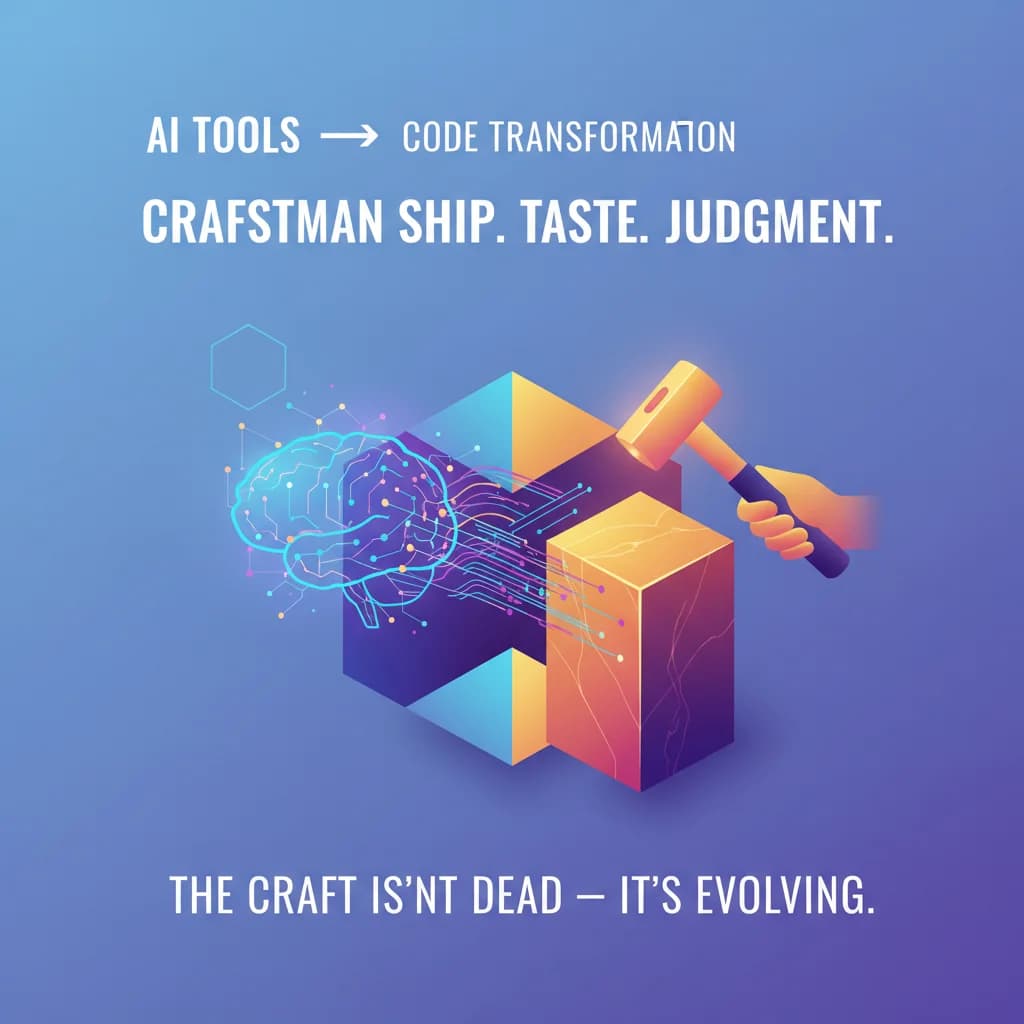
The tools have changed. The craft remains.
Keep building. Keep learning. Keep caring about the quality of what you ship. That's what separates engineers from prompt-button-pushers, and it always will.
Inspired by Scott Hanselman's reflections on the enduring nature of software craftsmanship.